Hi everyone,
I'm working on a new project, and I'm at the point where I'm trying to sort out the fuel delivery system. The car was originally carbureted, so no in-tank pump and return lines, etc. The motor I'm installing is a 2.3L Ford Duratec and it doesn't seem to use a return line. In fact, the fuel rail has no prevision for a return line at all - just in inbound fitting. Can anyone shed any light on why and when a return line is/isn't needed? I've always assumed all EFI systems used a return line, but apparently not in this case.
Secondly, is a surge tank necessary? The mega manual says "You only need a surge tank if you are using a low pressure pump to supply an external high-pressure pump..." That would lead me to believe it's optional, but I wanted to check with the group to get some more info. Again, this car was carbureted, so it has a very basic fuel tank, no baffles, internal tanking, etc.
Thanks!
Robert
Two questions: Surge tanks and return lines
Forum rules
Read the manual to see if your question is answered there before posting. Many users will not reply if the answer is already available in the manual.
If your question is about troubleshooting, configuration, or tuning, you MUST include your processor type (MS-I or MS-II) and code version in your post. If your question is about PCB assembly or modifications, you must also include the main board version number (1.01, 2.2 or 3.0).
If you have questions about MS1/Extra or MS2/Extra code configuration or tuning, please post them at www.msextra.com Such questions posted here will be moved to: a temporary MSextra sub-forum, where they will be removed after 7 days
The full forum rules are here: Forum Rules, be sure to read them all regularly.
Read the manual to see if your question is answered there before posting. Many users will not reply if the answer is already available in the manual.
If your question is about troubleshooting, configuration, or tuning, you MUST include your processor type (MS-I or MS-II) and code version in your post. If your question is about PCB assembly or modifications, you must also include the main board version number (1.01, 2.2 or 3.0).
If you have questions about MS1/Extra or MS2/Extra code configuration or tuning, please post them at www.msextra.com Such questions posted here will be moved to: a temporary MSextra sub-forum, where they will be removed after 7 days
The full forum rules are here: Forum Rules, be sure to read them all regularly.
-
73Inka2002
- MegaSquirt Newbie
- Posts: 30
- Joined: Sat Sep 18, 2004 2:21 pm
Two questions: Surge tanks and return lines
Car Info:1973 BMW 2002
MS Info: MSII v3.0, Code 2.871t4b (beta), MegaTune 2.25, EDIS-4, Innovate WB, Suzuki GSX-R Individual Throttle Bodies
MS Info: MSII v3.0, Code 2.871t4b (beta), MegaTune 2.25, EDIS-4, Innovate WB, Suzuki GSX-R Individual Throttle Bodies
Re: Two questions: Surge tanks and return lines
I believe you can use a pressure sensor in a single fuel rail to control the motor. Replaces the normal regulator and return line. Never tried it, though.73Inka2002 wrote:Hi everyone,
I'm working on a new project, and I'm at the point where I'm trying to sort out the fuel delivery system. The car was originally carbureted, so no in-tank pump and return lines, etc. The motor I'm installing is a 2.3L Ford Duratec and it doesn't seem to use a return line. In fact, the fuel rail has no prevision for a return line at all - just in inbound fitting. Can anyone shed any light on why and when a return line is/isn't needed? I've always assumed all EFI systems used a return line, but apparently not in this case.
My SD1 factory EFI has no surge tank - just a single external fuel pump. And of course a return line. I dunno how the fuel tank differers from the carb versions - other than in the pump arrangements. The car one uses an internal fuel pump. If your vehicle is going to be use off road or for racing, a surge tank would probably make sense.
Secondly, is a surge tank necessary? The mega manual says "You only need a surge tank if you are using a low pressure pump to supply an external high-pressure pump..." That would lead me to believe it's optional, but I wanted to check with the group to get some more info. Again, this car was carbureted, so it has a very basic fuel tank, no baffles, internal tanking, etc.
Thanks!
Robert
Dave P, London UK.
Rover V-8
MSII V3
EDIS
Tech Edge Wideband
Rover V-8
MSII V3
EDIS
Tech Edge Wideband
-
msiddalingaiah
- Helpful Squirter
- Posts: 68
- Joined: Fri Oct 09, 2009 7:39 am
- Location: Maryland, US
- Contact:
Re: Two questions: Surge tanks and return lines
A number of Fords use return less fuel systems just as trakkies mentioned. From what I am told, many other cars do the same. I built my own return less system using a Bosch Fuel Rail Pressure (FRP) sensor from a 2006 Ford Focus. It works quite well. You can read more about it under the "Fuel System" section of my build page: http://www.madhu.com/content/Main/FuelInjection73Inka2002 wrote:I'm installing is a 2.3L Ford Duratec and it doesn't seem to use a return line. In fact, the fuel rail has no prevision for a return line at all - just in inbound fitting. Can anyone shed any light on why and when a return line is/isn't needed? I've always assumed all EFI systems used a return line, but apparently not in this case.
Madhu
1990 Suzuki DR350S EFI Conversion
Returnless, adjustable electronic Fuel Pump Controller requires less power
1990 Suzuki DR350S EFI Conversion
Returnless, adjustable electronic Fuel Pump Controller requires less power
-
73Inka2002
- MegaSquirt Newbie
- Posts: 30
- Joined: Sat Sep 18, 2004 2:21 pm
Re: Two questions: Surge tanks and return lines
Great information, thanks very much gents!
Car Info:1973 BMW 2002
MS Info: MSII v3.0, Code 2.871t4b (beta), MegaTune 2.25, EDIS-4, Innovate WB, Suzuki GSX-R Individual Throttle Bodies
MS Info: MSII v3.0, Code 2.871t4b (beta), MegaTune 2.25, EDIS-4, Innovate WB, Suzuki GSX-R Individual Throttle Bodies
-
Kompressor
- MegaSquirt Newbie
- Posts: 8
- Joined: Mon Sep 20, 2010 8:54 pm
Re: Two questions: Surge tanks and return lines
msiddalingaiah - excellent material!
I know others have considered PWM on the fuel pump circuit, myself amongst them (I've adopted a fresh name to log in over here, I'm R100RT over @ MS).
That is probably the best way to nail fuel delivery requirements while reducing charging system burden to an absolute minimum. That could be the largest challenge on many bikes with such small output alternators and such. Appreciate the info - Lorne.
I know others have considered PWM on the fuel pump circuit, myself amongst them (I've adopted a fresh name to log in over here, I'm R100RT over @ MS).
That is probably the best way to nail fuel delivery requirements while reducing charging system burden to an absolute minimum. That could be the largest challenge on many bikes with such small output alternators and such. Appreciate the info - Lorne.
-
msiddalingaiah
- Helpful Squirter
- Posts: 68
- Joined: Fri Oct 09, 2009 7:39 am
- Location: Maryland, US
- Contact:
Re: Two questions: Surge tanks and return lines
Thanks! As you say, motorcycle EFI conversion is particularly challenging. I really struggled with the pump for quite some time. What we really need are more efficient pumps. Common vane pumps waste more than 90% of the power in heat. Piston pumps are more efficient, but suffer from pulsation. I think FRP control can solve that problem.Kompressor wrote:msiddalingaiah - excellent material!
I know others have considered PWM on the fuel pump circuit, myself amongst them (I've adopted a fresh name to log in over here, I'm R100RT over @ MS).
That is probably the best way to nail fuel delivery requirements while reducing charging system burden to an absolute minimum. That could be the largest challenge on many bikes with such small output alternators and such. Appreciate the info - Lorne.
If anyone knows of a decent fuel compatible piston pump, I would like to explore the idea further.
Madhu
1990 Suzuki DR350S EFI Conversion
Returnless, adjustable electronic Fuel Pump Controller requires less power
1990 Suzuki DR350S EFI Conversion
Returnless, adjustable electronic Fuel Pump Controller requires less power
-
Kompressor
- MegaSquirt Newbie
- Posts: 8
- Joined: Mon Sep 20, 2010 8:54 pm
Re: Two questions: Surge tanks and return lines
Seem's to be one of those things that doesn't reveal itself easily, small fuel pump sourcing.
I know others have done the search and found info on the net of that miniature Delphi unit - but you can't buy it.
I'm currently on the prowl for a similarly designed water pump to drive water injection which it would seem give best results when up in the 150-200psi range and very small orificed nozzles. Its proving to be equally as challenging, but I'm starting to find some product candidates that are miniature, low power draw, and ulta high pressure (low flow). I can locate pharmacutical type product but haven't been able to get ahold of a "sample" just yet (love the sample approach, if you can forward product requests with a company name attached at bottom of communication it is frequently offered).
Perhaps someone has located a really efficient small fuel pump?
I know others have done the search and found info on the net of that miniature Delphi unit - but you can't buy it.
I'm currently on the prowl for a similarly designed water pump to drive water injection which it would seem give best results when up in the 150-200psi range and very small orificed nozzles. Its proving to be equally as challenging, but I'm starting to find some product candidates that are miniature, low power draw, and ulta high pressure (low flow). I can locate pharmacutical type product but haven't been able to get ahold of a "sample" just yet (love the sample approach, if you can forward product requests with a company name attached at bottom of communication it is frequently offered).
Perhaps someone has located a really efficient small fuel pump?
-
msiddalingaiah
- Helpful Squirter
- Posts: 68
- Joined: Fri Oct 09, 2009 7:39 am
- Location: Maryland, US
- Contact:
Re: Two questions: Surge tanks and return lines
I know it sounds crazy, but I went and got a small 12V air compressor from Harbinger Freight to see if that could be salvaged. It is fairly high pressure, but low quality. I'm almost tempted to make something similar.Kompressor wrote:Its proving to be equally as challenging, but I'm starting to find some product candidates that are miniature, low power draw, and ulta high pressure (low flow). I can locate pharmacutical type product but haven't been able to get ahold of a "sample" just yet (love the sample approach, if you can forward product requests with a company name attached at bottom of communication it is frequently offered).
Perhaps someone has located a really efficient small fuel pump?
I didn't think about the medical industry. I've done a lot of research into fuel resistant materials if that's needed. Let me know what you find out...
Madhu
1990 Suzuki DR350S EFI Conversion
Returnless, adjustable electronic Fuel Pump Controller requires less power
1990 Suzuki DR350S EFI Conversion
Returnless, adjustable electronic Fuel Pump Controller requires less power
Re: Two questions: Surge tanks and return lines
What about a GM in tank fuel pump module. they are available for small four cylinder cars to high performance Corvettes and Camaros.
Search E-bay for fuel pumps
Are there fuel injected models of the 2.3 L Duratech engine search for that too.
Time to visit a local Pick A Part yard.
Search E-bay for fuel pumps
Are there fuel injected models of the 2.3 L Duratech engine search for that too.
Time to visit a local Pick A Part yard.
-
Six_Shooter
- MegaSquirt Newbie
- Posts: 18
- Joined: Wed Aug 18, 2010 6:27 pm
Re: Two questions: Surge tanks and return lines
The main thing that I didn't see covered in that home made PWM fuel pump controller is how it would adjust fuel pressure relative to manifold pressure.
In OEM systems, using a return or returnless system, the fuel pressure is adjusted relative to manifold pressure to keep the delta pressure the same, for more consistant control of fuel delivery.
Mechanical systems that use a return line, do this by using a vacuum referenced FPR.
In OEM systems, using a return or returnless system, the fuel pressure is adjusted relative to manifold pressure to keep the delta pressure the same, for more consistant control of fuel delivery.
Mechanical systems that use a return line, do this by using a vacuum referenced FPR.
-
DonTZ125
- Experienced Squirter
- Posts: 337
- Joined: Sat May 16, 2009 1:49 pm
- Location: Scarborough, ON
- Contact:
Re: Two questions: Surge tanks and return lines
A lot of bike systems are using non-return in-tank pumps; the regulator is in the pump housing and just dumps back into the tank. I would think this is fine for NA engines with predictable manifold pressure - you just tune for whatever fuel flow you get, whether your intake pressure is 100kPa or 40.
Boosted engines, with a variable manifold pressure, I could see absolutely requiring a referenced dP.
Boosted engines, with a variable manifold pressure, I could see absolutely requiring a referenced dP.

-
Kompressor
- MegaSquirt Newbie
- Posts: 8
- Joined: Mon Sep 20, 2010 8:54 pm
Re: Two questions: Surge tanks and return lines
My take on the PWM for fuel pump control is, nothing ventured , nothing gained.
It has potential to radically reduce current draw (critical on bikes with limited charging systems), reduce fuel heating, and I suspect with a bit more genius applied a reference to boost increase for fuel pressure to incrementally gain, might develope through a parallel sensor circuit ported to map (for inducted engines). If I have that right, lower resistance results in pwm increase on the Bosch sensor. In fact, the same sensor connected to manifold and wired in paralle to the fuel sensor might be an intesting experiment. If its the otherway around, then perhaps a series connection of the two.
I'm aquiring some product data sheets now on miniature high pressure water pumps that are capable of driving a water injection system, however that is off this topic. When I've also received pricing on those that can be purchased, I'll post those results.
It has potential to radically reduce current draw (critical on bikes with limited charging systems), reduce fuel heating, and I suspect with a bit more genius applied a reference to boost increase for fuel pressure to incrementally gain, might develope through a parallel sensor circuit ported to map (for inducted engines). If I have that right, lower resistance results in pwm increase on the Bosch sensor. In fact, the same sensor connected to manifold and wired in paralle to the fuel sensor might be an intesting experiment. If its the otherway around, then perhaps a series connection of the two.
I'm aquiring some product data sheets now on miniature high pressure water pumps that are capable of driving a water injection system, however that is off this topic. When I've also received pricing on those that can be purchased, I'll post those results.
-
Six_Shooter
- MegaSquirt Newbie
- Posts: 18
- Joined: Wed Aug 18, 2010 6:27 pm
Re: Two questions: Surge tanks and return lines
PWM stands for Pulse Width Modulation. PWM doesn't change resistance, it changes how much time a circuit in energized.
-
Kompressor
- MegaSquirt Newbie
- Posts: 8
- Joined: Mon Sep 20, 2010 8:54 pm
Re: Two questions: Surge tanks and return lines
May be a nob, but I understand how pwm works. My bad on poor gramar.Six_Shooter wrote:PWM stands for Pulse Width Modulation. PWM doesn't change resistance, it changes how much time a circuit in energized.

I meant to comment on the sensor, which changes resistance relative to fuel pressure which the module inturn translates to current control and dc motor speed regulation.
Adding a second sensor (perhaps for the sake of experimentation the same one used in msiddalingaiah's returnless circuit) - to map might allow boost correction lb for lb. on this novel approach.
-
msiddalingaiah
- Helpful Squirter
- Posts: 68
- Joined: Fri Oct 09, 2009 7:39 am
- Location: Maryland, US
- Contact:
Re: Two questions: Surge tanks and return lines
Bosch has already thought about the dP problem, look closely at the red vacuum cap on the FRP sensor:
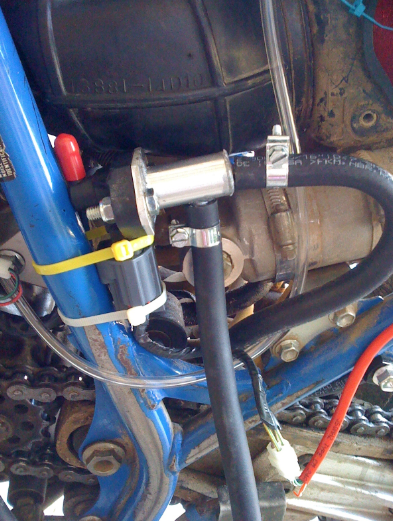
That's a vacuum reference port which gives you differential pressure. I capped it off because I was initially running constant pressure using a GSXR-1000 in-tank return less pump. As DonTZ125 mentioned, street bikes with in-tank pumps deliver constant pressure and don't take MAP into account. I had it tuned that way and I didn't feel like changing it. Anyway, MAP swings wildly on my single cylinder thumper, so I didn't feel like introducing another variable late in the game. It works for me.
The current generation Bosch sensors produce two voltage outputs: pressure and temperature. I characterized the pressure output and it is indistinguishable from Freescale five bar sensors. I strongly suspect Bosch purchases MPX5500 dies from Freescale, packages them with a fuel resistant die coating and adds a temp sensor. Freescale strongly discourages using their production sensors with fuel (and just about any other liquid). I contacted Freescale about this and they told me the Fluoro Silicone die coat in the MPX5500 washes away over time and calibration drifts. I suspect it might be possible to fill the MPX5500 with fuel resistant RTV or something and make it work. This is just a fall back plan in case Bosch sensors become hard to find.
I had an early prototype working with a VDO resistive pressure sensor. Here's a picture:
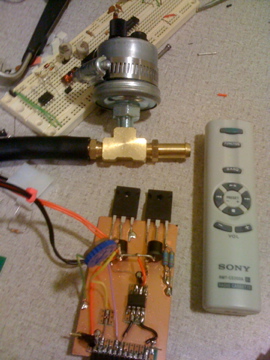
The VDO sensor (gray cylinder above) was designed to drive a gauge, so it was not very accurate and suffered from latency issues. It was at that time I stumbled on the Youtube video and found the Bosch FRP sensor designed precisely for this application. It was vindication that I was not crazy, or Bosch and Ford were as crazy I was
I have not characterized the fuel temperature output on the Bosch FRP sensor. I'll do that once I have a couple of spare ADC channels to log fuel pressure and temperature. Robert Bosch US was extremely helpful in obtaining basic data (e.g. pin connections), but they didn't have the output characteristics. They were willing to get Stuttgart on the line to find that, but I didn't press the issue. I was happy enough that they returned my call and gave me the pin connections
Kompressor, I am salivating over the mini high pressure pumps you mentioned...
That's a vacuum reference port which gives you differential pressure. I capped it off because I was initially running constant pressure using a GSXR-1000 in-tank return less pump. As DonTZ125 mentioned, street bikes with in-tank pumps deliver constant pressure and don't take MAP into account. I had it tuned that way and I didn't feel like changing it. Anyway, MAP swings wildly on my single cylinder thumper, so I didn't feel like introducing another variable late in the game. It works for me.
The current generation Bosch sensors produce two voltage outputs: pressure and temperature. I characterized the pressure output and it is indistinguishable from Freescale five bar sensors. I strongly suspect Bosch purchases MPX5500 dies from Freescale, packages them with a fuel resistant die coating and adds a temp sensor. Freescale strongly discourages using their production sensors with fuel (and just about any other liquid). I contacted Freescale about this and they told me the Fluoro Silicone die coat in the MPX5500 washes away over time and calibration drifts. I suspect it might be possible to fill the MPX5500 with fuel resistant RTV or something and make it work. This is just a fall back plan in case Bosch sensors become hard to find.
I had an early prototype working with a VDO resistive pressure sensor. Here's a picture:
The VDO sensor (gray cylinder above) was designed to drive a gauge, so it was not very accurate and suffered from latency issues. It was at that time I stumbled on the Youtube video and found the Bosch FRP sensor designed precisely for this application. It was vindication that I was not crazy, or Bosch and Ford were as crazy I was
I have not characterized the fuel temperature output on the Bosch FRP sensor. I'll do that once I have a couple of spare ADC channels to log fuel pressure and temperature. Robert Bosch US was extremely helpful in obtaining basic data (e.g. pin connections), but they didn't have the output characteristics. They were willing to get Stuttgart on the line to find that, but I didn't press the issue. I was happy enough that they returned my call and gave me the pin connections
Kompressor, I am salivating over the mini high pressure pumps you mentioned...
Madhu
1990 Suzuki DR350S EFI Conversion
Returnless, adjustable electronic Fuel Pump Controller requires less power
1990 Suzuki DR350S EFI Conversion
Returnless, adjustable electronic Fuel Pump Controller requires less power