Page 1 of 1
fuel regulator
Posted: Mon Apr 28, 2008 6:59 am
by blankczechbook
ms2 - 1.8zetec with 2.0cams. going with gsxr600 itbs and injectors...
am planning to try a regulator at the back of the car so i only need one fuel line, and shouldn't need to run a vacuum line back to it...
how many folks are running a set up like this? any std fitting inline regulator recommended??
ps - Hello - newbie & my first post so be gentle pls

Re: fuel regulator
Posted: Tue Apr 29, 2008 8:39 am
by devastator
As long as your regulator is on the end of your fuel rail, (and injectors), and before the tank, I don't see a problem with mounting the regulator by the tank in the back.
Re: fuel regulator
Posted: Tue Apr 29, 2008 9:01 am
by blankczechbook
...but i talking about before the rail and injectors - so i only run one fuel line from tank forwards,
if i also t in a small section to smooth any pulsing will this be enough or not - i know people have said it might be possible, but before i try it it'd be nice to know if it is then a pig to sort out - for a first timer i'll have more than enough on my plate already
these itbs tend to open up fast so the vacuum line would be more like an on/off signal anyway and again many have said not needed on a NA itb setup.
Re: fuel regulator
Posted: Tue Apr 29, 2008 11:02 am
by devastator
Are you adding the regulator or buying one? The vacuum line on many stock regulators is used to keep the pressure the same on both sides of the injector so that vacuum doesn't "pull" fuel out of the injector when it opens. The regulator SHOULD be on the end of the fuel rail, before the return line to the tank, however, several people run a low pressure pump to a "swirl pot" right before the fuel rail, providing for a single fuel line from the tank. The high pressure pump uses the fuel in this "pot" to feed the injectors. The remaining fuel goes through the regulator, (at the end of the fuel rail), and then returns to the "swirl pot" to be pumped out again. The low pressure pump refills the "swirl pot" as needed. I, personally, do not use a return line, just a tee off of the tank, but my tank is directly above the fuel lines and pump.
The ITB's won't open up fast enough to "outrun" the MAP sensor in Megasquirt, so it won't be an on/off signal. Most people I've read about with ITB's do run a line from each TB, tied into a tee, to their MAP sensor to smooth out the signal.
Re: fuel regulator
Posted: Tue Apr 29, 2008 10:20 pm
by blankczechbook
most cars use a regulator on the fuel rail after the injectors.
- how the return line is in plumbed in isn't really any issue - but for circulation to cool the fuel it's possibly better back to the tank...
but - most bikes use the regulator before the fuel rail - in the pump. so they dont need a return line or vacuum line for fuel supply. nor do they suffer from hot fuel.
i'd be aiming to do this too, unless i'm told reasons why it would fail - it'd be a neater install and less fuel connections - so safer?!
built in swirl pot - fuel pump tee'd to a regulator/back to tank, or from pump forward via filter to the rail. if this pulses then i'd tee in a hose section, and i can oversize the fuel rail to give a slight resevoir effect in the rail also.
- would this lead to fuel overheating? - would the fuel pressure drop at full loads/max flow?
BTW - i will be having the vacuum lines connected up to the MAF, but not to the regulator.
Re: fuel regulator
Posted: Wed Apr 30, 2008 7:29 am
by devastator
I have ample clearance in my fuel rails, and lines, to act as a slight reservoir already. My fuel doesn't get too hot and doesn't pulse. The EFI system I'd seen on a bike had the regulator on the return side of the fuel rail, (after the injectors, of course). I have read that it is not good to "dead head" fuel injectors like that, (regulator before the injectors), but have also seen these setups working fine. Flip a coin I guess. If you're using a MAF then will you be running Alpha-N instead of speed density?
Re: fuel regulator
Posted: Thu May 01, 2008 9:29 pm
by blankczechbook
yep - alphaN,
if anyone has reasons why this will be extra problematic then i'll go with the extra fuel line return and plumb in the reg after the injectors - but i suppose this isn't gonna be too bad to alter anyway if my first plan goes pearshaped..
cheers
Re: fuel regulator
Posted: Sun May 25, 2008 7:08 am
by Vicoor
The biggest problem to running the regulator without a "vacuum port" is that the changes in intake manifold pressure is not accounted for and makes accurate injection more difficult.
Also, the vehicles that run the regulator in the tank (returnless system) usually run higher fuel pressures in the 50-60psi range to prevent fuel vaporization at the elevated temperatures experienced without fuel circulation.
Re: fuel regulator
Posted: Wed May 28, 2008 12:10 am
by alienbush
Modern vehicles that use a returnless fuel system pulse width modulate the fuel pump to keep the pressure at the desired level. I don't believe Megasquirt has this ability.
Also, it seems to me that the regulator restricts fuel flow to build pressure, so if you put it at the tank then it would regulate pressure between the regulator and tank, and after the regulator would be a lower pressure. I'm not sure how good that would work. I would hook up a fuel pressure gage after the regulator to see what the pressure is doing in this set up.
But really it should be easy to run two fuel lines? They are routed right next to each other, so if you run one line, the other one is just laid right next to it.
Re: fuel regulator
Posted: Wed May 28, 2008 5:21 am
by devastator
I've been running a returnless fuel line set-up without any problems. My problem is not running another fuel line, but plumbing it in to the tank. My tank only has 1 outlet. You are correct, MS cannot control the fuel pressure by pulsing the fuel pump.
Re: fuel regulator
Posted: Wed May 28, 2008 9:03 am
by devastator
Thanks Lance. So you are running a non-return line setup on the Honda? Do you "dead head" the injectors? I mentioned in an earlier post that I'm running a tee off of the bottom of my tank, so the fuel that is not used by the injectors is returned, (after the regulator), to the available side of the fuel pump. The line after the regulator is larger than the "feed" line, this drops the pressure and also acts as a fuel "reservoir". This set-up is on a sandrail, so I never really considered epoxy to hold a return fitting on the aluminum fuel tank, but it would probably work just fine. My filler neck is only 1-1/2 inches long, so I'd have to attach the fitting to the tank, which is round BTW. I thought vibration might crack something, so I tried the tee and all has been alright so far. I have problems under boost, but the fuel pressure never falters, so I don't think the supply is the cause. Also worth noting is that I run E85, and a turbo, so I use a lot more fuel than the average engine of the same displacement.
Re: fuel regulator
Posted: Wed May 28, 2008 9:28 pm
by blankczechbook
i have an alloy filler elbow epoxied to my alloy tank and it's been there 6yrs so far without problems.
i am aiming for turning the key within a month or so - so we'll then begin to see if it is ok.
i have a schraeder valve near the regulator, but am thinking of putting another by the rail for checking pressure once running.. although this will be very hard to see under any sort of load

Re: fuel regulator
Posted: Tue Jun 03, 2008 2:41 pm
by cwest
[quote="Vicoor"]The biggest problem to running the regulator without a "vacuum port" is that the changes in intake manifold pressure is not accounted for and makes accurate injection more difficult.
Without trying to hijack this thread ,and picking up on the above,i fully understand the "why" but the "how "eludes me somewhat. Example, i have a 2lt N.A ,i have sized my injectors correctly ,now at idle i have manifold vac holding back fuel pressure by some amount and after some tuning i will have a good idle,,at W.O.T i have little manifold vac and full fuel pressure and again with tuning will be sweet,, at what point and by how much does fuel pressure change with a change in manifold vac? do i simply hook up a W.B and watch and hope the reg is capable of repeating the regulation each and every time or is there a better way? I know it is said ,do it this way but the nuts and bolts of it are not fully clear
It would seem as though if i had a fixed fuel pressure then it would be a more simple task to specify inj pulse width without a variation of fuel pressure.I do hope i made sense
always

Re: fuel regulator
Posted: Wed Jun 04, 2008 10:52 am
by devastator
I have a constant fuel pressure until I get boost pressure from the turbo, then my fuel pressure rises 1:1 with the boost pressure. My fuel pressure never drops, like many stock fuel systems. I know that many MS'ers have this setup though, and it seems to work well for them.
Re: fuel regulator
Posted: Thu Jun 05, 2008 5:04 am
by cwest
thanks,it seems to me it would be a more simple task to tune with a fixed pressure ,there is 1 less variable to add to the tuning equation
i am
Re: fuel regulator
Posted: Thu Jun 05, 2008 5:25 am
by blankczechbook
but you havent got fixed pressure across the injector, that's the point.. you'd only have fixed pressure behind the injector..
turbo'd cars need extra push to get the fuel into the pressurized inlet system and the amount of pressure change is much more than atmos cars get to see.
non turbo'd cars "suck" extra fuel as the vacuum in the inlet tracts increase...but not by so much difference - hence my aim to run the regulator without the vacuum line and tuning around it.
Re: fuel regulator
Posted: Wed Jun 11, 2008 11:14 pm
by blankczechbook
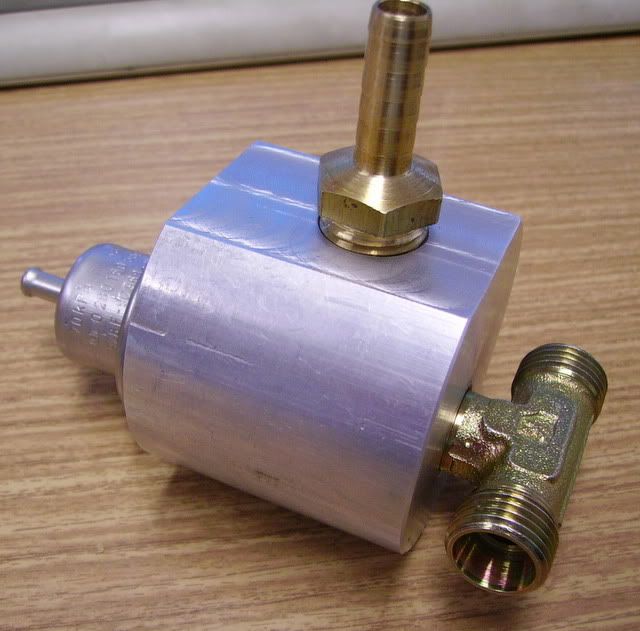
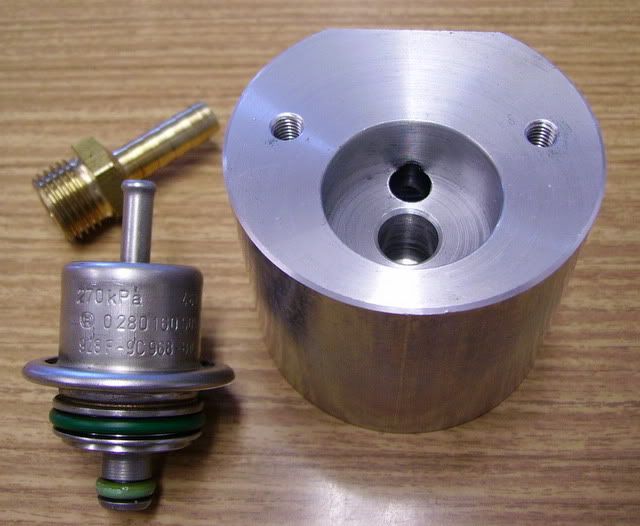
got my std fuel reg holder ready now... gonna use a std ford reg that i can squeeze up to higher pressures - these are cheap to get from breakers - so this way i can try different regulators set to different pressures easily.
have since found that some skoda fabias and some freelanders run without a fuel return from the fuel rail... and their pressures are fairly normal..
- but saw on the freelander a damper device on the rail - presumably for pressure spikes as the injectors open and close?? - i'm gonna tee in a section of fuel line to air dampen the pressure shocks a bit and see what happens.
Re: fuel regulator
Posted: Sat Jun 21, 2008 11:41 am
by Vicoor
cwest wrote:Vicoor wrote:The biggest problem to running the regulator without a "vacuum port" is that the changes in intake manifold pressure is not accounted for and makes accurate injection more difficult.
Without trying to hijack this thread ,and picking up on the above,i fully understand the "why" but the "how "eludes me somewhat. Example, i have a 2lt N.A ,i have sized my injectors correctly ,now at idle i have manifold vac holding back fuel pressure by some amount and after some tuning i will have a good idle,,at W.O.T i have little manifold vac and full fuel pressure and again with tuning will be sweet,, at what point and by how much does fuel pressure change with a change in manifold vac? do i simply hook up a W.B and watch and hope the reg is capable of repeating the regulation each and every time or is there a better way? I know it is said ,do it this way but the nuts and bolts of it are not fully clear
It would seem as though if i had a fixed fuel pressure then it would be a more simple task to specify inj pulse width without a variation of fuel pressure.I do hope i made sense
always
I think the mis-understanding begins when you think of there being " high vacuum" inside the manifold at idle. The way you need to view this is
Low Pressure.
The "vacuum" port on the regulator is a pressure sensing port. By applying the same pressure to the back of the regulator diaphram as is present in the manifold allows the regulator spring to keep a constant pressure differential between the fuel rail and the manifold. This way the injectors will always inject the same amount of fuel at a given pulsewidth.
So you could say that a constant pressure system maintains a constant pressure betwwen the fuel rail and the atmosphere, and as I said before a regulator with a pressure sensing port connected to the manifold maintains a constant pressure between the fuel rail and the inside of the manifold (across the injector) which makes it easier to predict the amount of fuel injected.